My Adoption Experience, What I have Learned
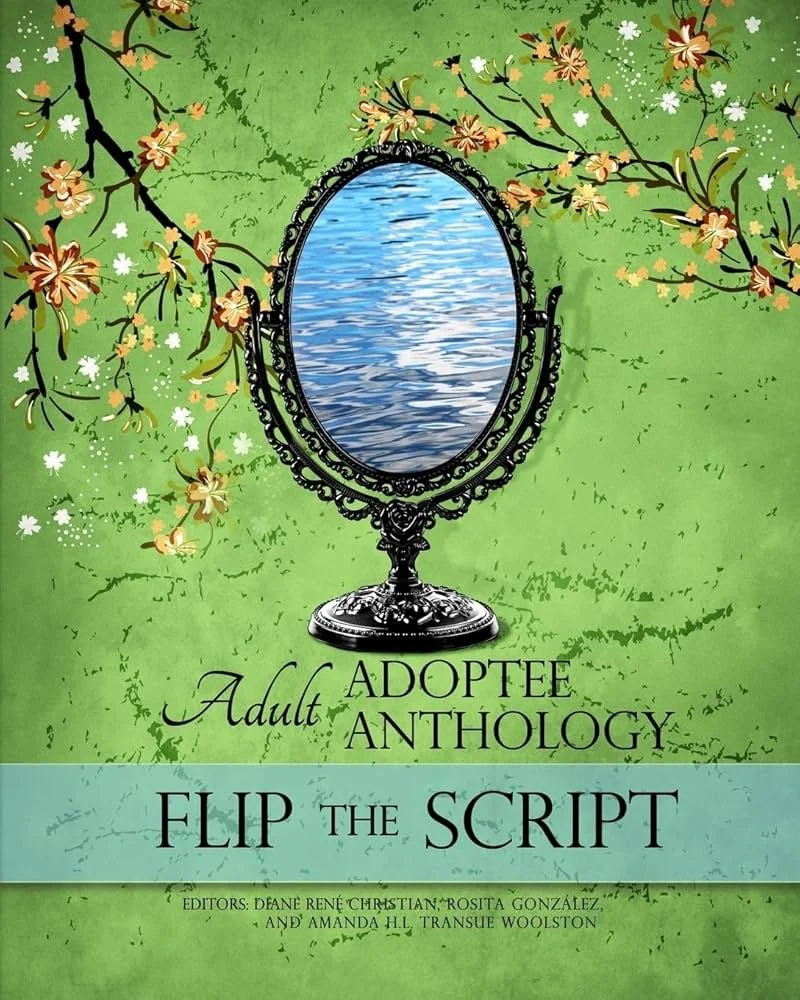
Originally Published in 2015 in Flip the Script: Adult Adoptee Anthology
The following essay was originally published in 2015 in Flip the Script: Adult Adoptee Anthology, edited by Diane René Christian, Rosita González, and Amanda H.L. Transue Woolston.
I am sharing it again as part of an ongoing reflection on adoption, identity, community, and the longevity of women’s voices in this work. Nearly a decade later, the core truths still hold.
My Adoption Experience – What I Have Learned
By April Dinwoodie
My life began when I was born, not when I was adopted.
For many years and sadly, sometimes even today, adoptions are transacted in a way that does not allow for an understanding of or connectivity to families of origin. My “birth” certificate lists my adoptive parents not my biological parents and even as a kid I found that odd. It did not in any way mean I did not love my parents or consider them my parents but… What happened between 1971 (my birth year) and 1973 (the year the certificate is dated)? Who were the two people who were fundamentally responsible for me being on the planet? Who were the people who took care of me for several months during my temporary foster care placement and with whom I spent my first Christmas? These people matter because they are a part of me; and all parts of a life matter. It took a long time to unravel both practically and emotionally that there was fundamental loss in gaining my adoptive family that love and cherish me and that I love and cherish right back. I am currently piecing together my beginnings and will have to do so without my biological mother’s perspective – she left the planet before I had a chance to meet her. My hope is that both professionals and parents embrace openness more and more allowing adopted people the access to the information and connectivity that fundamentally belongs to them and is part of them. We can’t love all parts if we do not know all parts.
Adoption is one word defined by many distinct realities.
For many years my adoption experience was all I knew. For a brief time, as a kid, I thought every family had at least one adopted kid and usually, that kid was brown. When no other brown adopted kids showed up at school, I realized that my family may indeed be unique. As my life unfolded and I gained connections to a community of people with the shared experience of adoption, I learned that the definition of adoption is simple but the realities of the lived experience are anything but. From foster care adoption to private domestic adoption to inter-country adoption – I have learned that how, where and why you enter into the adoption experience (and whether you have control over certain factors or not) matters and that even with a common bond our distinct realities differ as first/birth parents, adoptive parents and adopted people. One simple word that connects us, many unique lived experiences define us.
Being part of a larger community matters.
Adoption is a uniquely personal experience. I have learned the simple truths that if you have not experienced adoption personally, try as you might, it is likely you won’t fully understand it. As an adopted person, my life has been transformed by having other members of the adoption community as some of my dearest friends, partners, colleagues and confidants. I was not exposed to the wider world of adopted people, first/birth parents, adoptive parents and professionals until I was in my mid-twenties and starting my search in earnest. I have learned that my comrades in adoption can be my lifeline when no one else understands. There is a sense of calm in knowing that I do not even have to explain, they get it. Connecting children to these communities as early as possible can be transformational. I have learned firsthand how life-changing sharing in the common bond of adoption can be at any age but it is most beautiful when I see it unfold with young people. Although all of our stories are distinct, there is a common bond in living adoption.
Perceptions, policies and practices must be reformed.
The general public’s perceptions of adoption are often shaped by polarizing news stories or Hollywood depictions of the fairytale or the nightmare. While there is no doubt some adoption narratives make great headlines, so many people experiencing adoption do not live the headlines in their everyday lives. Most of us live somewhere in between and all of us would benefit from more understanding and more modern sensibilities surrounding the realities of adoption. In the absence of uniform best practices and vastly different policies state by state, professionals, parents and adopted people are often left to navigate the complexity of their realities without the support they need. Even after decades of lived experience and research from Donaldson Adoption Institute (DAI) and others, adoption is so often treated like a one-time transaction instead of a lifelong transformation. We know what to do; now we need to actually start doing it.
The adoption community is more powerful together.
I have learned there is power in numbers. Changing perspectives and truly employing what we know from research and lived experience to ensure families are stronger will take a concerted effort. Unraveling the powerful and longstanding entities that are counting on the fact that as a community we will remain fractured and less strong means we need to find every opportunity to stand together. Our different experiences make us a rich tapestry and finding the connecting points where we can agree and come together will be critical as we move forward. Together, we can accelerate positive change in how people perceive, think and behave about adoption—making it about people instead of process. Together, we can make adoption about building strong families instead of just building toward a final court date. Together, we can show the world that adoption is not a mere transaction, but a lifelong transformation.